A Rainy-Day Window for Reading a Stream
A rainy-day window for reading a stream offers a quiet way to notice bends, banks and surface patterns from a suitable public viewpoint, without entering the water.
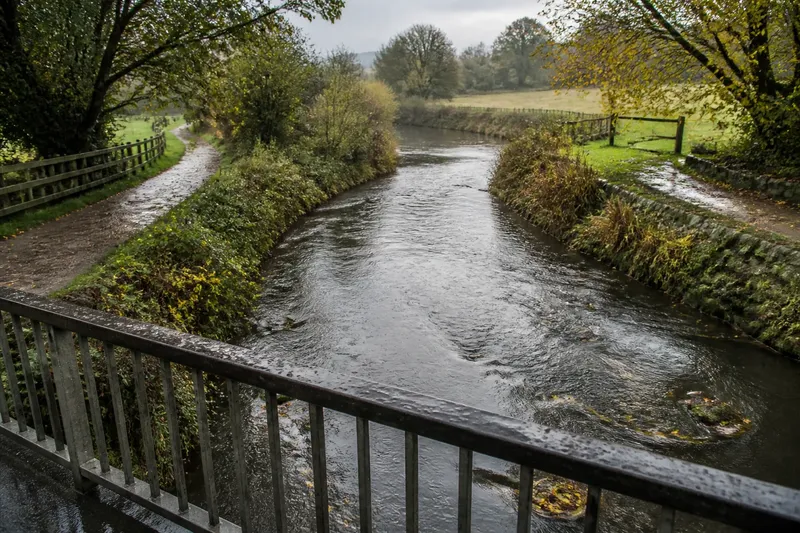
Rain taps the bus shelter roof while a stream slips beneath the footbridge, carrying a scatter of leaves past the downstream rail. A rainy-day window for reading a stream is a chance to notice how its bends, banks and surface patterns organize what you can see, without stepping into the channel or deciding what the water means for its health.
Choose a public path, bridge or other viewpoint where you can stand back from the bank. Keep the observation modest: describe the visible movement, the shape of the channel and the weather that is changing the scene. A stream is not a report card, and a bright patch or muddy swirl is not enough to diagnose one.
Where can you watch without approaching the water?
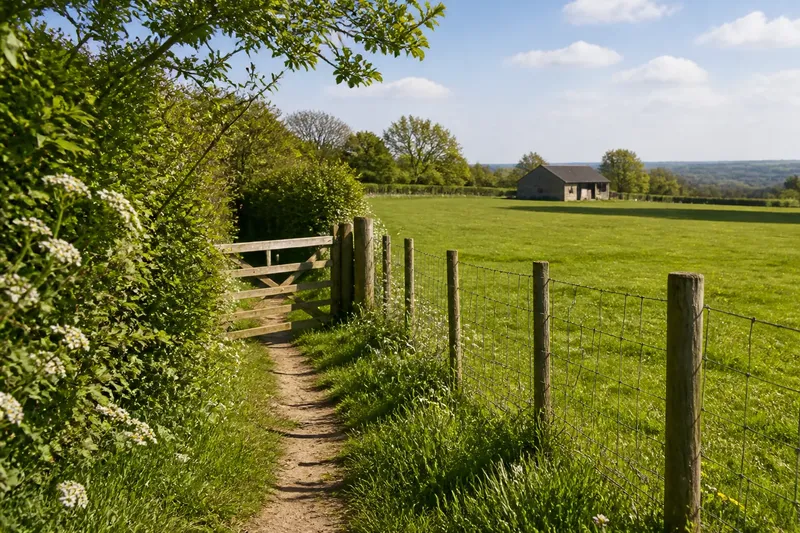
A public footbridge can offer a useful view of the channel from above, while a riverside path may show a longer stretch and its banks. A marked viewpoint or a broad, firm path-side stopping place can work too. The best spot is not necessarily the closest one; it is the place where you can look without leaning over, blocking other walkers or stepping onto soft ground.
Stay on the public route and respect signs, gates and private boundaries. Avoid narrow banks, slippery stones and overhanging edges, especially when rain has made the ground slick. If the view requires crossing a fence or leaving the path, choose another view. The stream will continue its business without a closer inspection.
At a bridge, look from the public walkway rather than climbing onto a parapet or reaching through railings. Keep a comfortable distance from traffic and give other people room to pass. If the weather makes the route uncomfortable or visibility poor, a shorter look from a safer place is a complete observation.
What does a bend tell you about the view?
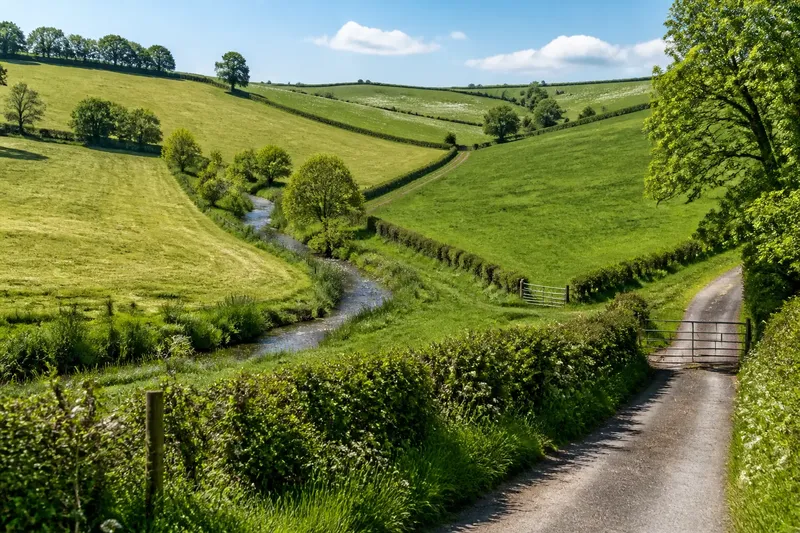
A bend changes which parts of the stream are visible at once. From the outside of a curve, the bank may look steeper or more exposed; on the inside, a shallower margin or a small area of deposited material may be easier to see. These are descriptions of form, not a claim about why the channel took that shape.
Try following the curve with your eyes from upstream to downstream. Note where the water disappears behind a bank, hedge or stand of trees, then where it returns to view. A bend can make a short stream seem to vanish and reappear, rather like a ribbon passing behind a chair leg.
Use plain location words: left bank, right bank, inner curve, outer curve, near side and far side. If you use left and right, say which way you are facing, since the labels switch when you turn around. Such small choices make a note useful later instead of leaving you with an elegant but unlocatable “there.”
How can you describe the banks?
Look at the visible edge where land meets water. Is it low and gradual, cut into a distinct face, hidden by grass, or interrupted by roots? Are there patches of bare soil, reeds, stones or fallen leaves? Record what you can see, without assuming that one bank is stable or that a particular feature has a single cause.
Rain can make details easier to spot and harder to interpret. Dark soil may stand out against pale grass; a thin trickle may cross the bank; a fresh-looking mark may be old, or may have appeared since the last shower. “A narrow wet line below the grass” is more careful than “the stream has flooded.” The first is an observation. The second needs more evidence than a window-side visit can supply.
Notice what borders the bank as well as the bank itself. A fence, hedge, path, field edge or bridge may limit the view and shape how people approach the water. For this outing, treat those features as landmarks rather than turning the walk into a survey of land boundaries.
Which surface patterns are worth noticing?
Watch a small section of water for a little while. You may see smooth stretches, narrow ripples, tiny eddies beside a projecting stone, or a line of bubbles that splits around an obstruction and joins again. Describe where the pattern appears and what it does. Avoid turning a visual clue into a claim about depth, speed or water quality.
Reflections can be especially changeable on a rainy day. A gray sky may make the surface look dark; a gap in the clouds can put a bright patch over one part of the channel. Raindrops stipple the surface, while wind may roughen one exposed stretch and leave another comparatively calm. The view changes with the weather, not just with the stream.
Look for contrasts rather than a single label such as “fast” or “still.” You might note that the center carries a broken line of ripples while the water beside the bank looks smoother. That comparison is easy to check from the path and gives a more exact account of the scene than guessing at a current.
What can you record in a short field note?
A useful note can fit in a pocket notebook or the notes app on your phone. Record the viewpoint and the conditions alongside the visible features, so you do not later mistake a rain-darkened scene for a permanent one. A compact entry might include:
- Viewpoint: name the public bridge, path or recognizable landmark.
- Weather: note whether rain is falling, has recently stopped or is passing in showers.
- Channel shape: describe a bend, a straight reach or a section hidden from view.
- Bank details: list visible grass, roots, stones, bare patches or structures.
- Surface pattern: locate ripples, smooth patches, reflections or small eddies.
- Change: if you revisit, say what looks different without guessing at the cause.
Keep the wording observational. “Leaves turn in a small swirl near the far bank” gives another reader something to look for. “The water is dirty” turns color or suspended material into a judgment, while the cause and meaning remain unknown from this viewpoint.
How do rain and viewing distance change the picture?
Rain adds motion to the surface and can blur the boundary between water and bank. Falling drops create rings; runoff may arrive in thin lines; wet leaves darken and cling to the edge. Those details are worth noting as conditions, not as proof of a lasting change in the stream.
Distance matters too. From a bridge, the surface pattern may be clear while the bank materials are difficult to distinguish. From a path beside the water, you may see roots and grasses but lose the shape of the channel as it curves away. Each viewpoint gives a partial picture; moving to a second public viewpoint can add another angle if the route is safe and open.
Say you stop on a public bridge after a shower and see a leaf circling beside a low branch, with a smooth patch farther downstream. You could note the location of the swirl, the branch and the smooth water, then add that the rain has just eased. The note would describe a scene someone could revisit, without claiming the stream is blocked, unusually high or in poor condition.
What should you ask yourself while watching the stream?
Which way is the water moving?
Choose a leaf or another visible floating object and watch whether it travels past a fixed landmark. If it is hard to tell, describe the surface without assigning a direction; reflections and circular eddies can make movement confusing.
Why is one patch of water darker?
It may reflect a different part of the sky, a shadow or the bank, but appearance alone does not settle the cause. Record where the dark patch lies and whether it shifts as clouds or your viewing angle change.
Does a swirl mean there is an obstruction?
A visible swirl marks a surface pattern, not a certain explanation. If a branch or stone is plainly nearby, note both; do not infer what lies below the surface.
Can I tell whether the stream is healthy?
A single view cannot establish the condition of a stream. Color, foam, litter or a strong smell may prompt concern, but observations from a public viewpoint are not a full assessment; if you think there is an immediate hazard, keep away and contact the relevant local authority.
How can you leave the observation useful?
End with a small, checkable detail: the bend that hides the far bank, the ripples that gather near a bridge pier, or the patch of grass leaning toward the channel. If you return in different weather, compare only what is plainly visible from the same public place. That keeps the record grounded in observation rather than a theory assembled from one rainy afternoon.
For a rainy-day window for reading a stream, a dry notebook and a steady viewpoint are enough. The point is not to decode the whole watercourse, but to notice how the view is put together and leave the bank exactly as you found it. Bring a hood, keep your footing on the path, and let the stream keep the rest of its particulars.