Hedge or Fence: What Each Boundary Does for a Landscape
Hedge or fence choices change sightlines, enclosure and the feel of a field edge. Learn what to notice as you read a rural boundary on foot.
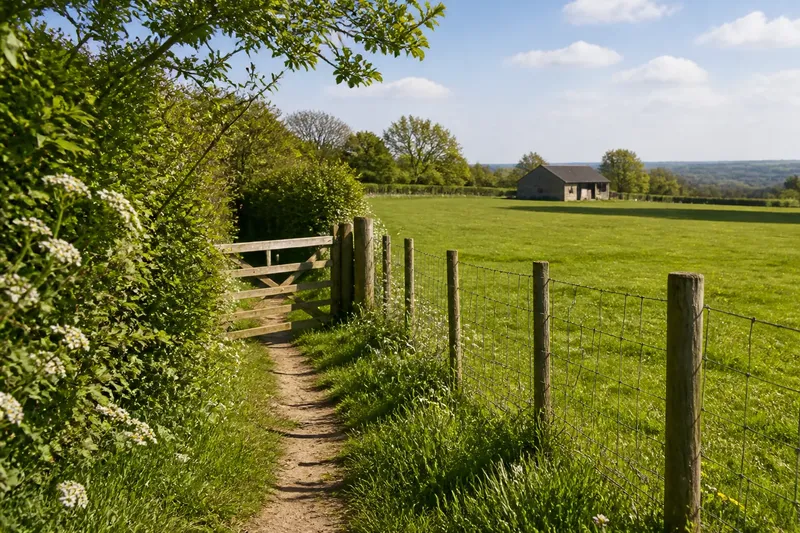
A field gate stands open beside a clipped hedge, and the pasture beyond appears in flashes between leaves. A few yards along, a wire fence makes the same field edge easier to trace but harder to overlook. To read a hedge or fence in a rural landscape, look beyond the question of what marks the boundary: each changes what can be seen, how enclosed the land feels and how the edge meets its surroundings.
What changes when a boundary is leafy or open?
A fence usually draws a legible line. Rails, wire or mesh let the eye travel through or over the boundary, so a field can feel broad even when access is physically restricted. A hedge takes up more visual space. Its foliage screens some views, gives depth to the edge and can make the same field seem smaller or more sheltered.
That difference is not simply a matter of height. A low, gappy hedge may frame a wide view, while a tall, dense one can conceal most of the field. A close board fence blocks the eye more thoroughly than open wire. Material, gaps, upkeep and the land on either side all affect the result.
Think of a boundary as a curtain or a window screen: one may interrupt a view, while the other filters it. Neither tells you by itself who owns the land or why the boundary is there. The visible effect, however, gives a useful clue to how the edge organizes the scene.
How can you read sightlines along an edge?
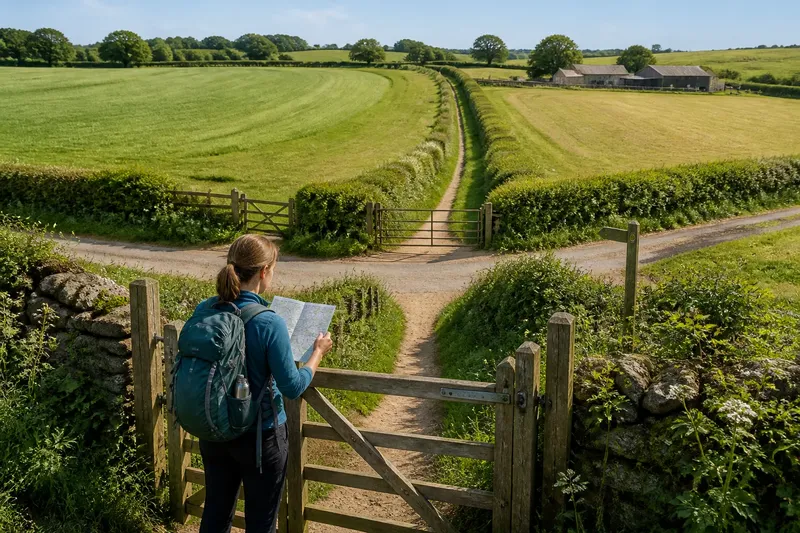
On a walk, pause at a gate, a bend and a point where the boundary changes form. At each place, notice whether you can see across the field, along its edge or only through occasional gaps. A hedge often offers a sequence of partial views as you move; a fence may keep a longer, more continuous line of sight.
Look at what the boundary frames. A hedge may hide a shed until the path curves, then reveal its roof above the leaves. A fence may leave the same building in view for much of the walk. Neither arrangement is accidental in appearance, even when no single purpose is obvious: edges can screen, divide, guide the eye or simply follow the land.
Also check the height of the observer’s view. A walker on a raised path may see over a hedge that feels closed from the field below. From a low point, a wire fence can nearly disappear against grass, while its posts remain visible. A landscape is read from a position, not from an imaginary viewpoint hovering above it.
When does a boundary make land feel enclosed?
Enclosure is a visual impression as well as a physical one. A hedge can create a room-like field by closing the view at its edges, especially where it is continuous and tall. A fence may define the same space without giving it that enclosed feeling, because the eye can still pass through its structure.
Gaps matter. A broken hedge can make an edge feel porous, although it still reads as a boundary from a distance. A fence with a gate, a corner post or a change in direction often makes the line explicit even when the surrounding view stays open. The result can be a curious combination: clear division, little visual shelter.
Enclosure also depends on what lies beyond the boundary. A hedge beside another close hedge can make a narrow lane feel contained. The same hedge beside open pasture may seem like a thin screen in a broad view. Compare one edge with its surroundings before deciding that it is inherently “closed” or “open.”
What should you notice during a week’s walk?
A short routine helps separate the boundary itself from the first impression it makes. Choose a public path that passes a few different field edges, and revisit the same stretches during ordinary walks across a week. There is no need to cover ground quickly; a gate or bend is a better observation point than a hurried glance from the middle of a field.
- On the first walk, note the materials. Record whether the edge is a living hedge, wire, rails, boards or a combination, and mark where one changes into another.
- On the next walk, compare openings. Look for gates, gaps, corners and changes in height. Decide whether each opening interrupts a view, gives a glimpse through or leaves the sightline mostly unchanged.
- Later in the week, watch the view from more than one position. Compare a low point, a rise and a bend. Notice what becomes visible or disappears as the viewing height and angle change.
- On a subsequent pass, consider enclosure. Ask whether the edge makes the field feel like a contained space or keeps it visually joined to the surrounding land. Include the boundaries opposite and beside it in that judgment.
- On the final walk, describe the edge without assigning a purpose. Write down what it does to the view: screens a building, marks a long line, breaks the field into smaller scenes or leaves the horizon open. Then note any purpose you suspect as a separate thought.
Say you follow a public footpath beside a pasture, first along a dense hedge and later beside wire fencing. At the hedge, the pasture may appear in short openings and a distant barn may vanish behind leaves; at the fence, the barn may remain visible while the field edge is easier to trace. Those are observations about the view, not evidence that either boundary was chosen for that reason.
Why do boundaries change along one field?
A hedge may end at a gate and continue as wire, or a fence may give way to a planted edge. Read the change as part of the scene rather than treating it as a mistake in an otherwise tidy pattern. Gates, corners, entrances and changes in terrain can make a different kind of boundary more visible or convenient at that particular point.
Look for the transition itself. A run of posts may stop where a hedge thickens; an opening may preserve a long view through a leafy edge. The shift can make the field’s outline easier to understand, or create a brief visual break that draws attention to an access point.
Keep possible explanations distinct from what you can see. A fence might be there for a practical reason, but its appearance alone does not tell you the landowner’s intention. If a specific boundary’s purpose matters, local context or reliable information is needed; the view can support a question, not settle it.
Which questions help distinguish a hedge from a fence’s effect?
Does a hedge always hide more than a fence?
No. A thin, trimmed or gappy hedge can allow broad views, while a close-board fence can block them. Judge the particular edge by its height, density and openings rather than its name.
Can a fence make a field feel enclosed?
Yes, especially when it is solid, tall or repeated with other boundaries nearby. An open fence can still make the division clear while leaving the field visually connected to its surroundings.
What does a mixed hedge-and-fence boundary tell me?
It tells you that the edge changes in form, and that change may affect the view or the sense of enclosure. It does not, by itself, explain the reason for the combination.
Is the most visible boundary always the most important one?
Not necessarily. A low or partly concealed boundary may still mark an edge, while a prominent fence may draw the eye without telling you anything about ownership. Keep visual prominence separate from legal or practical status.
How can you describe a boundary without guessing?
Use plain observations: “the hedge screens the lower field,” “wire leaves the hill visible,” or “a gate breaks the line beside the lane.” These descriptions say what the boundary does to the view. Words such as “private,” “defensive” or “traditional” suggest meanings that the appearance alone may not establish.
Compare edges using the same questions: How continuous is the line? What can be seen through, over or around it? Does it make the field feel more enclosed? Does it lead the eye along the boundary or out into the landscape? Returning to those questions gives a steadier reading than calling one type attractive and the other bare.
The next time you follow a field edge, use the hedge or fence as a guide to the scene’s sightlines, not as a complete explanation of the land. A careful description of what is screened, revealed or kept visually open is already useful. It also leaves room for the simplest honest observation: sometimes the boundary changes the view, while its reason remains out of sight.